Dry Rub vs Wet Sauce — Which Flavors Survive the Drive Home
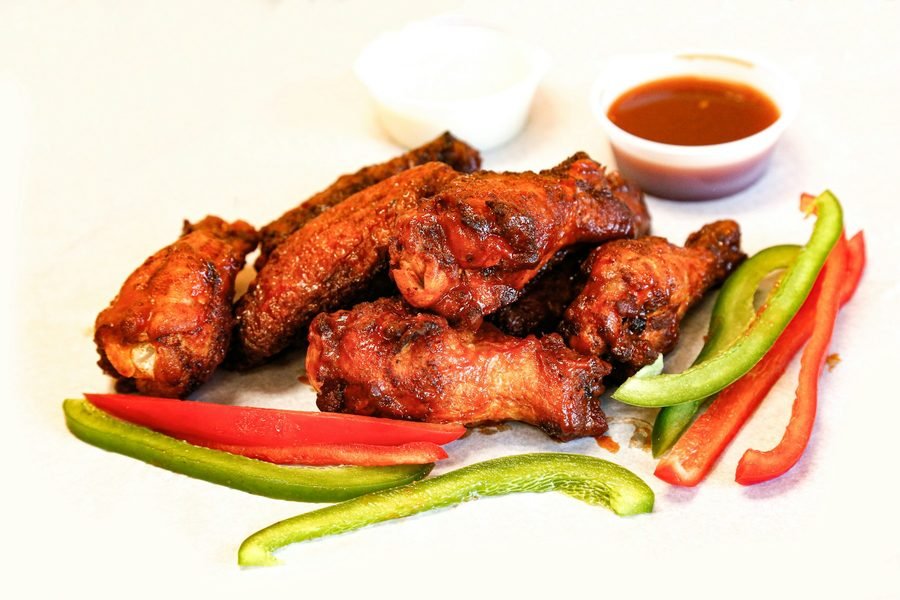
Every guide lists the twelve flavor names. Almost none tells you which are dry rubs and which are wet sauces, and that is the distinction that decides whether your order is good when you actually eat it.
It matters more than the flavor names do, because it changes the texture, the travel and what happens when you add a dip.
The split
Five of the twelve are dry rubs — seasoning applied to the fried wing with no sauce at all. The other seven are wet sauces, tossed on and dripping.
The rubs are Lemon Pepper, Garlic Parmesan, Louisiana Rub and Hot Honey Rub, with Cajun carrying rub seasoning worked into a sauce base. Everything else is wet.
- Dry rubs — Lemon Pepper, Garlic Parmesan, Louisiana Rub, Hot Honey Rub
- Wet sauces — Atomic, Mango Habanero, Cajun, Original Hot, Spicy Korean Q, Mild, Hickory Smoked BBQ, Hawaiian
Why it decides the order
A dry rub leaves the skin intact. It stays crisp through the box, through the car journey and through the twenty minutes it takes a group to work through a large order. Nothing is softening it.
A wet sauce begins softening the coating the moment it is applied. Eaten immediately that is fine and arguably the point — the sauce is meant to soak in a little. Eaten twenty-five minutes later it is a different wing, and not a better one.
<strong>The rule: dry rubs for delivery and collection, wet sauces for eating in.</strong> This one habit improves more takeaway orders than anything else on this site.
The free workaround
If you want a wet sauce on a travelling order, ask for the sauce on the side. It is free, it is a routine request at a place that fries to order, and you get the wing exactly as the kitchen made it plus full control over how much sauce goes on.
Ask for extra crispy at the same time. A longer fry gives firmer skin that holds up considerably better in a closed container. Also free, and almost nobody asks.
Between those two requests, a delivery order of Hickory Smoked BBQ arrives in roughly the condition a Lemon Pepper order would have. Without them it does not.
The calorie surprise
People assume a dry rub must be lighter than a sauce. The board says otherwise: Lemon Pepper and Garlic Parmesan are both 240 calories, and Hot Honey Rub is 260 — the joint-heaviest on the menu.
Meanwhile Cajun and Original Hot are 20 calories each. The lightest flavors here are wet sauces and the heaviest are rubs, which is the exact opposite of the assumption.
The seasoning blends carry oil, which is what makes them cling to the skin. That is the same property that makes them travel well, so the two facts are connected rather than coincidental.
What to order when
Eating in, straight away: any wet sauce. This is when Original Hot, Mango Habanero and Spicy Korean Q are at their best and it is the only time they are.
Collecting or delivery: Lemon Pepper, Garlic Parmesan, Louisiana Rub, Hot Honey Rub. Or a wet sauce with the sauce on the side.
Feeding a group over an hour: rubs, without question. A box of wet-sauced wings sitting open on a table for forty minutes is considerably worse at the end than the beginning; a box of rubbed wings barely changes.
Frequently asked
Which Wingstop flavors are dry rubs?
Lemon Pepper, Garlic Parmesan, Louisiana Rub and Hot Honey Rub. Cajun carries rub seasoning in a sauce base.
Which flavors travel best?
The dry rubs, comfortably. They keep the skin crisp because there is no sauce softening it.
Can I get a wet sauce on the side?
Yes, and it is free. It is the correct order for anything travelling more than about ten minutes.
Keep reading
Boneless vs Bone-In Wings — the Calorie Fact Everyone Gets Backwards
Boneless are breaded breast meat. They are heavier than classic at every single count.
Read →
You Can Order More Than One Flavor — and It Is Free
The most underused feature on the menu, and it costs nothing.
Read →
How Hot Is Atomic, Really?
Hot in about two seconds, and it builds rather than fading.
Read →