Tenders vs Boneless Wings — What Is Actually Different
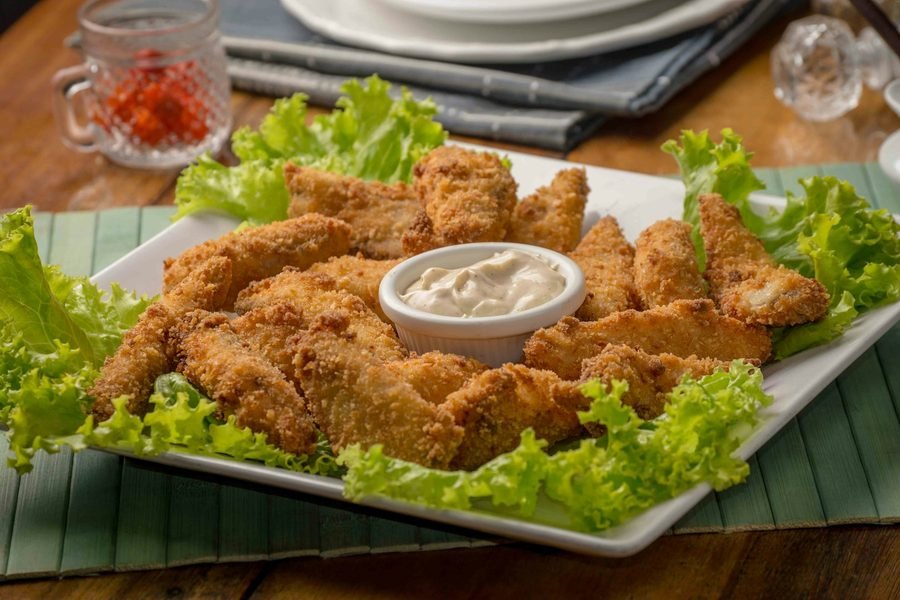
People assume tenders and boneless wings are the same product in different shapes. They are close relatives rather than the same thing, and the differences matter more than the menu suggests.
Both are breaded white meat with the same flavour range available. Everything else differs.
Different cuts, different texture
Tenders are whole chicken tenderloin strips — a specific muscle, cooked as one piece. Boneless wings are portioned pieces of breast meat shaped to wing size.
The texture you notice is the pull. A tender has grain running through it and comes apart in strands; boneless are more uniform and denser, closer to a nugget in structure.
Neither is better in the abstract. A tender eats more like chicken; boneless eat more like a snack. Which you want depends on whether you are having a meal or picking at a box.
On price, boneless wins per piece
A 10-piece boneless is $8.39. Four tenders is $6.29 and seven is $9.99, so tenders run roughly $1.43 each against 84 cents for a boneless piece.
But a tender is considerably bigger than a boneless piece. On actual chicken per dollar the two land closer together than the headline suggests, and at the larger counts tenders arguably win — 20 tenders at $28.29 is a lot of meat.
The clean comparison is against bone-in: 20 tenders at $28.29 against 20 bone-in wings at $18.29. Ten dollars more, and considerably more chicken, because there is no bone in the equation at all.
The dip allocation differs
Tenders come with dips built into the count: one with the 4-piece, two with the 7-piece, three with the 15-piece, four with the 20 and 30-piece.
That last one is worth noticing. Four dips across thirty tenders is not enough — it works out at seven and a half tenders per dip, and a dry tender is a poor thing. Order extra at $1.49.
Boneless wings by the piece come with no dips at all. Factor that in when comparing prices, because a dip is not optional with breaded chicken.
Which suits which situation
Tenders for children. Familiar, easy to portion, no negotiation, and the 3-piece combo at $8.69 is the lightest complete meal on the menu at 1,375 calories including fries and a drink.
Tenders for eating at a desk. A tender is a two-finger food; a boneless wing wants a fork or a napkin per piece.
Boneless for picking at over an evening, and for a group box where people take a couple at a time. The smaller pieces suit sharing better.
Neither if you wanted a wing. Skin is doing real work on a classic wing that breading cannot replicate, and both of these are breaded.
Flavours work differently on each
Dry rubs are excellent on tenders. The breading holds seasoning without going soggy, and a Lemon Pepper tender is genuinely good.
Wet sauces are better on boneless, where the smaller pieces mean more sauce per bite and the format suits a messier eat.
On either, take the sauce on the side if the order is travelling. Breading softens faster than skin does, so a sauced tender twenty minutes out is noticeably worse than a sauced wing.
Frequently asked
Are tenders and boneless wings the same?
No. Tenders are whole tenderloin strips; boneless are portioned breast meat. Tenders are larger and have more pull to them.
Which is better value?
Boneless per piece, tenders per gram of chicken. Against bone-in, tenders give considerably more meat because there is no bone.
Do tenders come with dips?
Yes — one with the 4pc up to four with the 30pc. Four dips across thirty tenders is not enough; order extra.
Keep reading
Boneless vs Bone-In Wings — the Calorie Fact Everyone Gets Backwards
Boneless are breaded breast meat. They are heavier than classic at every single count.
Read →
How Many Wings Per Person? A Straight Answer
Six to eight bone-in per adult. Boneless are more food than they look.
Read →
The Cheapest Way to Eat Here
The cheapest meal is $6.29. The cheapest line is $1.49.
Read →